How Do HVAC Companies Answer Calls After Hours? 5 Options
Forward to the on-call tech, pay an answering service, let it go to voicemail, put an AI on the phone, or text the caller back. What each one does at 8:40pm in July, and how to check yours tonight.
By Samuel Rojas ·
How do HVAC companies answer calls after hours? Options include an on-call tech, a live HVAC answering service, voicemail, an AI receptionist, or missed-call text-back. The right setup depends on your call volume, emergency rules and booking needs. Confirm who responds, when coverage applies, and what happens if a call or text fails.
Here's what each one does with the same call: 8:40pm on a Tuesday in July, the house is at 88°, and the homeowner has three other HVAC numbers in their search results.
How many after-hours HVAC calls you're dealing with
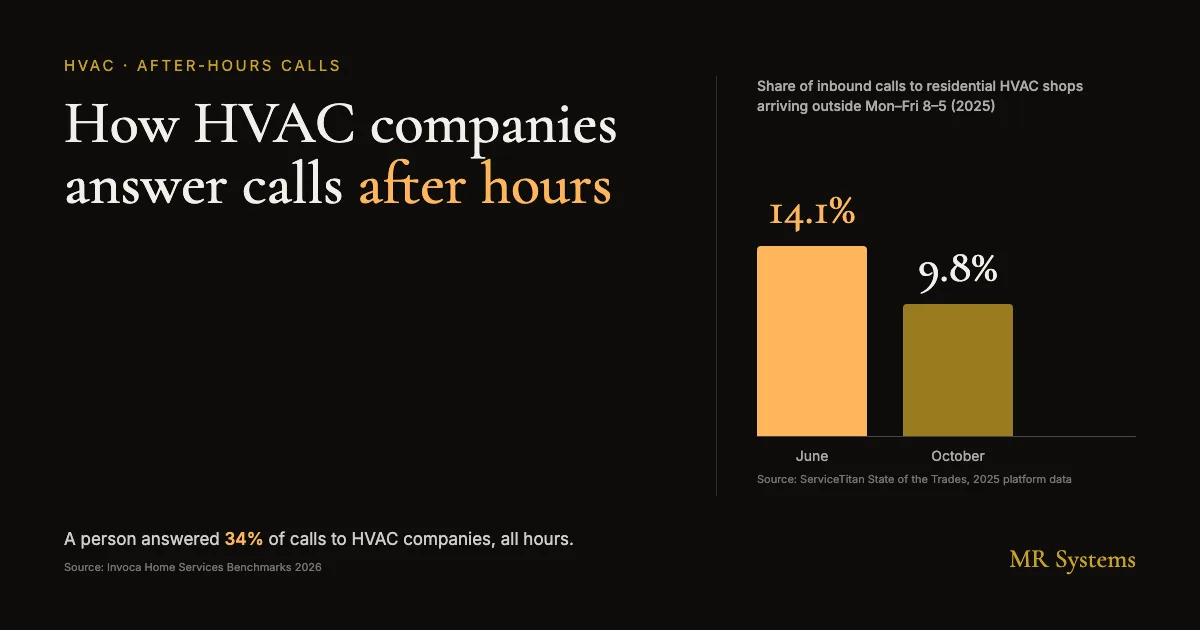
About one call in seven in June, going by the best numbers available. ServiceTitan looked at inbound calls to residential HVAC shops on its platform through 2025. In June, 14.1% of calls arrived outside business hours, and in October it was 9.8%, the low point of the year. They counted anything outside Monday to Friday, 8am to 5pm as off-hours. The biggest cluster was 5pm to 9pm, when people get home to a hot house. There was a smaller bump from 6am to 8am, after a bad night.
Two caveats from ServiceTitan's own fine print: it's their customers only, and it isn't nationally representative. It's still the cleanest HVAC-specific data I've found.
Answering is a problem in daylight too. Invoca, a call-tracking company, published its 2026 home services benchmarks from calls across its own customers. A person answered 52% of home services calls overall. For HVAC it was 34%, second lowest of the nine trades they list. Those are all calls, day and night, so the after-hours gap sits on top of a phone that's already hard to reach.
Nobody has published a trustworthy dollar figure for after-hours calls specifically. You'll see big numbers on vendor sites, and most of them don't link to any study. Your own math is better. Pull last June's call log from your phone system and count the calls outside 8 to 5. Then count how many of those got a person or a callback within the hour. The calls nobody reached, times the share you'd normally book, times your average ticket, is your number.
The five options at a glance
| Option | Who picks up | Does the caller get a booked visit? | Who gets woken up | Main risk |
|---|---|---|---|---|
| On-call tech | Your tech, on their cell | Yes, if they answer | The tech, for every call | Missed while on a job or asleep |
| HVAC answering service | A call center operator | Often a message and a callback | On-call tech, emergencies only | Message-taking; per-minute bills in a heat wave |
| Voicemail | Nobody | No | Nobody | Caller dials the next company |
| AI receptionist (voice) | An AI voice agent | Yes, if it's connected to your schedule | On-call tech, emergencies only | Callers who hang up on a bot |
| Missed-call text-back | A text from your number | Yes, if an assistant books by text | On-call tech, emergencies only | Landlines; callers who already moved on |
Option 1: Forward the line to an on-call tech
The main number rings the on-call tech's cell (or the owner's) after 5pm. A lot of small shops start here.
What works: the person answering knows HVAC. They can ask the right two questions, hear that it's a real no-cool with a newborn in the house, and get in the truck.
What breaks: the tech is under a house on another call, driving, or asleep, so the call goes to their voicemail anyway. Every "how much is a tune-up?" call rings someone's cell at 10pm, and a rotation like that wears people down fast.
Who it fits: shops with a few techs who are fine splitting a rotation, where after-hours volume is low.
Option 2: A live HVAC answering service
A live operator can answer after hours and escalate calls under your script; confirm coverage and overflow handling with the provider.
What works: a live operator can screen calls so your tech gets the ones your script flags for a truck tonight.
What breaks: many services take a message instead of booking, so the homeowner still waits for your callback. Operators usually cover many companies at once, so anything off-script ("is this the same brand you put in last year?") gets "someone will call you back". Billing is usually per minute or per call, which climbs in a heat wave.
Who it fits: shops with steady after-hours volume who want a human voice and are OK with message-taking for routine calls.
Option 3: Voicemail with an emergency greeting
The call goes to a greeting that says your hours, what counts as an emergency, the after-hours fee, and how to reach the on-call tech.
What works: it's free and honest.
What breaks: the homeowner at 88° hangs up and calls the next number. Voicemail asks the caller to wait, and someone with no AC has other options to try.
Who it fits: shops that really don't take after-hours work and want to set expectations.
Option 4: An AI receptionist on the phone
An AI voice agent answers the call, asks what's wrong, and books the visit into your schedule or pages the on-call tech. ServiceTitan sells one (its Virtual Agent), and so do a growing number of startups.
What works: an AI voice agent can handle calls outside office hours and book when the scheduling integration supports it; test routing and failure handling.
What breaks: some callers hang up the moment they hear a bot, and you won't know how many. Setup takes real work: your prices, service area, emergency rules and fees all have to be written down, and a wrong answer on an emergency call is a bigger deal than a wrong answer about parking.
Who it fits: higher-volume shops already on dispatch software that supports it, willing to listen to recordings for the first few weeks.
Option 5: Missed-call text-back with booking by text
The phone rings the on-call tech or goes to voicemail like it does now. Within seconds, the caller gets a text from your business number: "Sorry we missed your call! What's going on with your system?" From there an assistant sorts emergency from next-day, offers real open times, and books.
What works: nobody hears a bot. The homeowner gets a reply while they're still looking at their phone, and the morning team gets a written record of every after-hours conversation.
What breaks: landlines can't get the text. Some callers will have already dialed the next company by the time they read it. Automated texts sent to US recipients from a local 10-digit number require A2P 10DLC registration; allow time for provider approval. Toll-free numbers and short codes use separate routes.
Who it fits: small and mid-size shops that want to follow up with missed callers by text without staffing a phone overnight.
Full disclosure: this is the one MR Systems builds. MR Systems is an agency building websites, AI front desks and business automations for US service-business owners. You can watch a missed-call text-back book an AC repair for a demo HVAC company, or try the live demo yourself as the homeowner. Our prices are on the pricing page.
What a good after-hours setup does, whichever option you pick
Whichever option you choose, judge it on what the caller gets in the first two minutes:
- A reply in seconds. A human, a bot or a text, but something. The caller at 88° is checking other numbers while they wait.
- One question to sort the emergency. "Is the system completely off, and is anyone in the house at risk from the heat?" Your rule decides what happens next. Gas smell always goes to 911 or the gas company.
- The fee said up front. If after-hours visits cost more, say so before booking. Surprises at the door turn into bad reviews.
- A real time, not "we'll call you". For next-day jobs, offer two open slots from your actual calendar.
- The on-call tech gets a text, not a voicemail. Name, address, what's wrong, and whether it's urgent, so they can decide from the truck.
- A morning summary. Everything that came in overnight, what was booked and what still needs a call.
The difference between options is mostly how many of these six they do on their own.
How to test your own line tonight
It takes ten minutes, and it's the only way to see what a homeowner sees.
- At 8:30pm, call your main number from a phone your team doesn't know. Count the rings. Write down who or what answers.
- Say your AC is blowing warm air and you want someone out tomorrow. Note whether anyone asks if it's an emergency, mentions a fee, or offers a time.
- If it goes to voicemail, leave a message and time how long until someone calls or texts back.
- Text your main number. A lot of business lines can't receive texts at all, and customers try it anyway.
- Do it again Saturday at 2pm.
If any step ends with silence, that's where your after-hours HVAC calls are leaking. We ran a version of this test on 24 med spas after hours.
If you'd rather we run it for you, book 30 minutes and we'll call your line after hours and send you what happened.
Questions owners ask
How do HVAC companies answer calls after hours?
Options include forwarding to an on-call tech, using a live HVAC answering service, voicemail with an emergency greeting, an AI receptionist, or missed-call text-back. Shops can combine them: an answering service can screen calls and page the on-call tech for emergencies. Confirm coverage and booking support before choosing.
When do most after-hours HVAC calls come in?
Evenings. ServiceTitan's 2025 data on residential HVAC shops found the biggest share of off-hours calls lands between 5pm and 9pm local time, with a smaller bump from 6am to 8am. Off-hours calls were 14.1% of inbound calls in June and 9.8% in October.
What counts as an HVAC emergency after hours?
Write down your emergency rules so whoever answers follows the same script. Consider no heat in freezing weather, dangerous indoor heat with vulnerable people, or water leaking from the system. A caller who smells gas should leave the house and call the gas company or 911, rather than wait for an HVAC booking.
Do customers mind talking to an AI receptionist?
Test that with your own callers rather than assuming a preference. Voice asks the caller to speak with an assistant during the call; text lets them read and reply later. Either channel should identify the assistant plainly and offer a handoff to a person. Track hang-ups and replies during your trial.
What is missed-call text-back?
When a call to your business number isn't answered, the system sends the caller a text from that same number within seconds, something like 'Sorry we missed you, what's going on with your system?' The conversation continues by text, either with your team in the morning or with an assistant that can sort emergencies and book a visit.