Med Spa Lead Response Time: We Messaged 24 Med Spas After Hours
One question, sent on a Wednesday night: how much for Botox and lip filler, and can I come in next week? Here is who answered, how fast, and who never did.
By Samuel Rojas ·
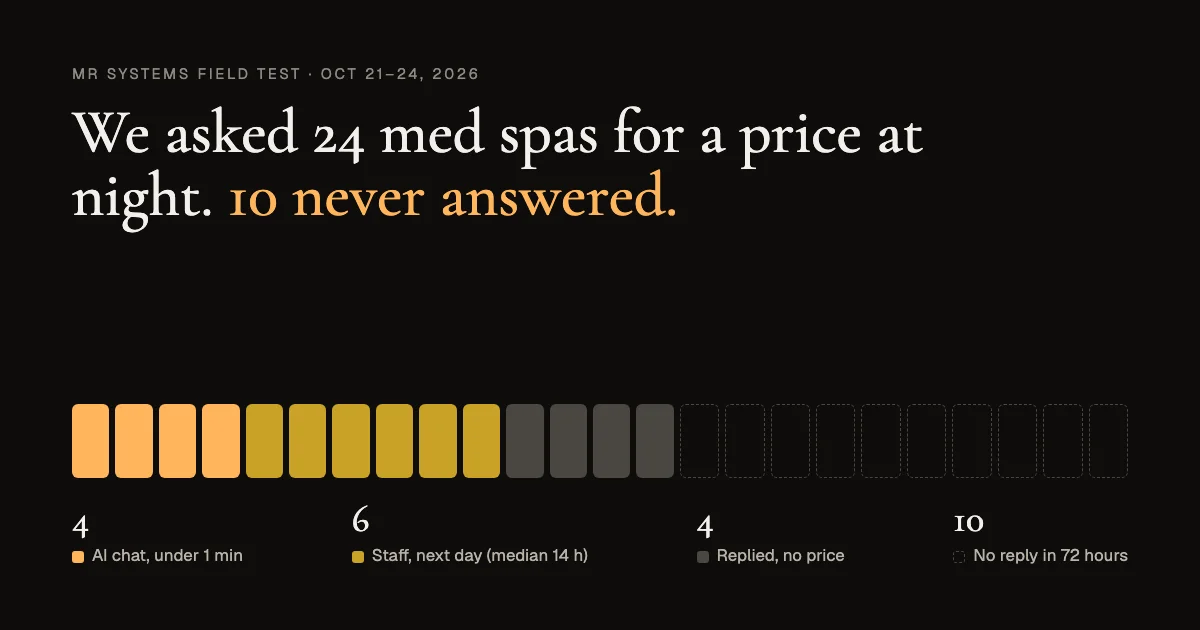
We sent the same question to 24 med spas between 8pm and 10pm local time on Wednesday, October 21, 2026: the price of forehead Botox, the price of lip filler, and whether there was an opening next week. Ten never replied within 72 hours. Four answered in under a minute, all of them AI chat. The six spas where a person answered took a median of about 14 hours, and none of them answered the same night.
That spread is what med spa lead response time looks like from the patient's phone. Most owners have never seen it from that side. Patients reach out after work, so this is the window that counts.
What we sent, and to whom
The test was one message per spa, written as a new patient named Pedro, sent through whatever the website offered: a contact form, a booking request form, a "text us" widget or a live chat. It asked three things: how much forehead Botox costs, how much lip filler costs, and whether there was an opening next week.
We started from a list of 30 med spas. Six were skipped because the only way in was a CAPTCHA or a bare email address. That left 24, in Florida, Georgia, Texas, Tennessee and Arizona. Fourteen were reached through a form and ten through a chat or text widget.
We tracked three things for 72 hours: when the first message of any kind arrived, when someone actually answered the price question, and whether anyone offered a time to come in. Texts, emails, calls and voicemails all counted.
This was a prospect list, not a random sample of the industry, and 24 spas is a small number. Treat the percentages as what happened to these 24, not a national rate. We are also an agency that sells AI lead follow-up, so read it with that in mind. We aren't naming any spa, and we didn't book or keep any appointment.
What happened to all 24 messages
| What happened within 72 hours | Spas | Share |
|---|---|---|
| Price answered by AI chat, under 1 minute | 4 | 17% |
| Price answered by a person, next day or later | 6 | 25% |
| Replied, but never gave a price | 4 | 17% |
| Never replied at all | 10 | 42% |
One of the four AI answers was partial: it quoted lip filler from $515 and said Botox would be priced at a free consult. We still count it, because it gave a number and a next step.
Ten spas never replied, even with a chat widget
Four in ten said nothing in three days: no text, no email, no call.
A chat widget didn't change that. Three of the ten silent spas had a "text us" or chat box on the site that took the message and showed a confirmation like "a representative will contact you shortly." Nobody did. The other seven were forms, including one that told visitors "we typically respond within 24 hours."
We can't see inside these businesses. The form may route to an inbox no one checks, or the widget may be tied to a phone number that changed. The patient can't tell the difference, and doesn't care.
Staff answered the next morning at the earliest
Six spas had a person answer the price question. Every one came the next day or later.
| Spa (by state) | Channel | Time to a real answer |
|---|---|---|
| Florida, Orlando area | text | 10 h 8 min |
| Florida, Orlando area | text | 11 h 50 min |
| Florida, Boca Raton area | text | 13 h 48 min |
| Florida, Tampa | 14 h 41 min | |
| Florida, Boca Raton area | text | 15 h 45 min |
| Texas, Houston | text | 36 h 21 min |
The fastest human reply landed at 7:47am the next morning. The median across the six is 14 hours 15 minutes.
That lines up with the inside view. Aesthetix CRM's study of 200+ aesthetic practices found the median practice's first message from a person comes 12 hours 13 minutes after a lead arrives. Their numbers come from practices already using a CRM with automations. Ours come from the outside, from spas picked off a prospect list, and they're a little slower. And 15 of our 24 never heard from a person at all within three days, against 48.9% of leads at their median practice within a week.
Fourteen hours matters because the patient doesn't wait for you. Harvard Business Review's study of 2,241 companies found that firms that contacted an online lead within an hour were nearly seven times as likely to qualify it as firms that waited even an hour longer. Our test patient messaged several spas in the same city on the same night. Real patients do the same thing. Whoever answers first with something useful is the one they talk to.
The instant auto-text did not speed up the answer
Nine spas sent something within two minutes. On a dashboard that's a 38% instant-response rate. Read the messages and it shrinks.
Four were AI chats that answered the question, which we'll get to. One was an AI chat that ignored it. The other four were acknowledgments like "a team member will personally respond during business hours" or "thanks for reaching out, our team will reach out soon." For three of those, the actual answer came 10, 12 and 16 hours later. The fourth, an email inviting us to get scheduled, was followed by three texts and a call and never a price.
The auto-text tells the patient the message landed, and that's worth something. All it bought these spas was time, and they spent that time asleep, which is fair at 9pm. They answered the next morning or afternoon, and by then our test patient already had prices from four other spas.
AI chat answered in seconds but couldn't book a time
The four spas running an AI chat or AI text responder answered the actual question in under a minute, most within 10 to 25 seconds:
- Botox per unit and lip filler price, a free consult, and a booking link
- Botox units for the forehead at $13 a unit, lip filler $450 to $800, and $50 off a first visit
- A Botox starting price and lip filler starting price, then "which days next week work?"
- Lip filler from $515, Botox priced at a free consult, and a request for a phone number to check openings
None of them could see the calendar. Two said so outright ("I can't see live openings"). The best they could do was a booking link. A fifth AI chat replied in under 10 seconds with "How can I assist you today?" and ignored the question entirely, so we didn't count it as an answer.
Only one spa out of 24 offered a specific time to come in: a person at a Boca Raton area spa, who texted the next day with prices and "11:30am tomorrow." A patient who asks "do you have anything open next week?" is asking to book. Most replies, human or AI, answered half the question.
More follow-up didn't help without an answer
Some spas followed up hard. One Texas spa reached out seven times over four days: four templated texts pushing a booking link (the last one, on day four, opened with "Still thinking about it?"), a text from a staff member and two voicemails. It never once said what Botox costs. Pedro still doesn't know.
A Miami spa texted three times and called once, each time asking for a call or a day to come in, with no price. In fairness to that spa, its form had no message field. It never saw the question. Two of the 24 forms had no box for a message at all, so the patient can't ask "how much is it?" until someone calls.
Following up is fine. Seven messages that dodge the one question asked read like a marketing drip, and that's how patients will file them.
What the prices looked like
Here are the prices quoted to us, for anyone curious how much they vary. They were quoted to a stranger by text, so they're starting prices, not final ones:
- Botox: $9.99, $13, $14 (twice) and $15 per unit; one spa quoted $240 flat for the forehead
- Lip filler, one syringe: from $450 (a promo) to $950, with most quotes between $700 and $800
- Also offered: one spa didn't carry Botox and offered Dysport at $3 a unit on a first-visit promo
Every spa that gave a number still pushed for a booking or a consult in the same message. Saying the price didn't cost them the pitch.
For phone calls rather than website messages, our guide to how HVAC companies answer calls after hours compares on-call techs, answering services, voicemail, voice AI and missed-call text-back. The same coverage questions are useful when checking your med spa's phone line.
How to fix your after-hours lead response
You can do most of this with the tools you already pay for. The goal is a real answer while the patient is still holding the phone.
- Answer the top three questions instantly: price ranges for your most-asked services, whether you have openings, and where you're located. An AI front desk can do this from your own menu, at 9pm, in under a minute. Four spas in our test already do this.
- Offer a real time along with the link. The gap in every AI reply we got was the calendar. Whatever answers after hours should be able to read your schedule and offer two times, or the patient goes looking elsewhere for one.
- Put a message box on every form. If a form only takes name, phone and email, the patient's question dies in the form and your follow-up opens blind.
- Test your own lead path every month. Fill out your own form and chat at night from a number your team doesn't know, and time it. If your widget or form is silently broken, this is the only way you'll find out.
- Give the morning team one job before 9:30. Clear every overnight lead with an actual answer, not another "when can you talk?"
If you want to see the first two working, try our AI front desk demo with a med spa scenario. Ask it for Botox pricing and an opening next week, which is the same thing we asked these 24 spas. Or book 30 minutes and we'll run this same test on your own site and send you the timeline.
Questions owners ask
How fast should a med spa respond to a new lead?
Acknowledge every lead within a few minutes and answer the actual question within the hour. Harvard Business Review found firms that reached online leads within an hour were nearly seven times as likely to qualify them as firms that waited longer. In our test, staff answered the next morning at the earliest, a median of about 14 hours after the message.
Does an automatic text count as responding to a lead?
It counts as an acknowledgment, not an answer. Four of the spas we messaged sent an instant 'we'll be in touch' message. Three took 10 to 16 hours to answer the price question, and the fourth never did.
Should a med spa give prices by text?
Give the range you already publish or would say on the phone. The spas that answered our question with a number gave a per-unit Botox price and a per-syringe filler price in one or two lines. The spas that replied without a price asked us to call or book a consult instead, and none of those replies moved us closer to a booking than a number would have.
What should an after-hours AI receptionist for a med spa do?
Answer price and service questions from the spa's own menu, offer real open times, and hand anything clinical to staff. The AI chats in our test did the first part in seconds. None of them could check the schedule. They sent a booking link or asked for a phone number.
How can I test my own med spa's response time?
Fill out your own website form and chat widget from a number your team doesn't know, at 9pm on a weekday, with a specific question about price and availability. Write down when the first message arrives, when a person answers the question, and whether anyone offers a time.